
WORLD-CLASS MANUFACTURING
Pipelife’s Timmy Mullins and Eoghan Considine chat about implementing Lean and why they’re taking sustainability seriously
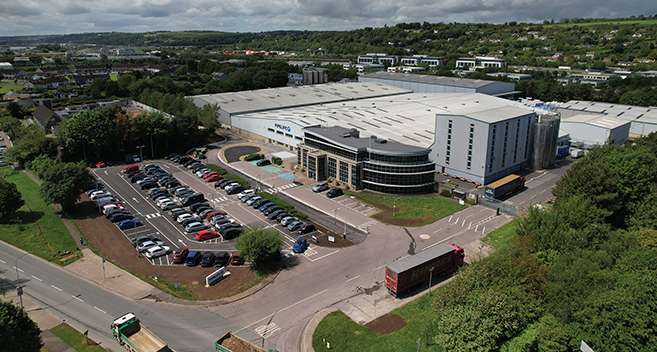
For over 50 years, Pipelife has specialised in the extrusion of polyethylene (PE) pipes for sectors including heating & plumbing, water pressure, electricity, cable ducting, gas and agriculture. Over the past two years, significant investment has gone into its Little Island facility, with the aim of modernising and future-proofing the plant for the next few decades. “We expanded and upgraded the site and we’re on target to operate 35 state-of-the-art extrusion lines that incorporate the latest automation technologies. The plan is to produce 45,000 tonnes per annum by 2026,” said Timmy Mullins, Pipelife Marketing Executive. Investment has also gone into a training academy, with every member of staff undergoing training in Lean. The emphasis is on minimum waste, maximum efficiency and ensuring staff can adapt to whatever changes are coming down the line.
That focus on Lean extends to all areas of the company, including the extrusion lines. “We have made significant efforts to increase energy efficiency in the extrusion lines and to achieve that, we took a Lean approach. For example, if we previously did a length of pipe at 50m, that could have ended up with an additional 100mm. By implementing better processes through Lean, we’ve been able to reduce the amount of raw material going to waste.”
The team has improved accuracies around what’s sold. “That guarantees we sell the right length all the time. Our machines are producing just what we need – there’s no wastage. We have upgraded almost all our machines so we’re working within a very modernised plant.”
Sustainability is, says Specification Manager Eoghan Considine, a key element of the business. “In 2025, we put in place a sustainability team which I’m part of. That team is undertaking courses in University of Limerick to enable us to implement a site-specific sustainability plan, but I think the real energy efficiency comes into play on the manufacturing side. In 2025 we published our first EPD (Environmental Product Declaration) and we have another five on the way.”
The plan is to have an EPD for every product that Pipelife manufactures. In addition wienerberger, the group that owns Pipelife, has requested that all third-party goods brought in by Pipelife also have an EPD. “That means our suppliers have to put in the work to produce EPD’s for their goods. We’re also busy preparing for 2028, when all buildings over 1,000 sq m must calculate and report their lifecycle GWP emissions. By 2030, every product in every building will require an EPD. We’re the first pipe manufacturer in Ireland to provide an EPD – that puts us in a prime position to service some of the bigger PLC builders around Ireland, along with the Government agencies that have green procurement rules,” says Eoghan.
Producing the first EPD wasn’t an easy process, says Eoghan. “It took us about a year to get our first one across the line. It was a huge learning process. I think probably the biggest element was gathering information that we never would have gathered before – everything from where the product comes from when it’s being extracted from the earth, energy, transport and packaging, to what happens at the end stage of the product and how it’s recycled.” The goal is zero waste and that means ticking every box along the way. “We went back to our supply chain and asked them to provide us with the information we needed. One thing the whole process highlighted was that our supply chain isn’t necessarily primed for this journey. They’re getting on board though – it’s a learning curve for us all.”
Many of Pipelife’s customers are PLC’s with stringent CSRD requirements. “They need to report on their scope 1, 2 and 3 and we play a part in that. They put pressure on us to produce EPD’s and in turn, we pass those requirements onto our suppliers. It will get to a point where we’re being benchmarked against competitors and the same thing will happen to our supply chain. If we have an alternative supplier that’s offering a competitive price, along with lower embodied carbon, that will dictate who we select as our suppliers.”
Alongside investment in the facility, acquisitions play an important role at the company. In 2025, Pipelife acquired MPF Sales Ltd, a manufacturer of high-quality drainage, roofline and cable ducting systems. “That acquisition has enhanced our product range and increased revenues. MPF has production facilities in Dublin and distribution in Belfast so they’re a valuable addition. Acquisitions are an important element of the business; they help to improve and widen both our offering and our customer base,” said Timmy.
Recruitment can be an issue. “We’re based in a part of Ireland that has eight of the top 10 pharmaceutical companies. When you’re looking for staff, that’s huge competition to be up against. It can be a challenge to find production and manufacturing staff, but that’s part of the reason for the investment. Staff facilities have been enhanced and career progression is encouraged,” says Timmy.
With ongoing acquisitions and investment to modernise the facility, the future is looking bright, says Timmy. “As a Guaranteed Irish member, the investment in new equipment, staff training and services is unique in our sector. It has positioned us as a world-class manufacturer and I think it shows Pipelife’s long-term commitment to the Irish market. It’s also just the start – we’ve got more plans in place to improve the facility even further.”
______________________________________________________________________________________
Michael McDonnell Managing Editor of Irish Construction Industry Magazine & Plan Magazine
Email: michael@irishconstruction.com WWW.MCDMEDIA.IE